tiistai 21. helmikuuta 2012

Thinking About Brand Strategy..


Starbucks follows global marketing strategy with some slightly adjustments with respect to local culture and language. The concept of place to stay with cup of coffee works pretty the same in all foreign markets. The only changes Starbucks makes is a menu content, though the changes are usually related to local preferences, for example American menu has more sandwiches and burgers, Italian is supplemented with some spicy pastries, Russian one contains a lot of cheesecakes and pies. For the Finnish one it could be proposed to offer different sorts of bread, especially dark one, plus Finnish traditional "pulla" and "pirakka".  Drinks menu may also have some patterns related to the local culture.


Apart from German entry in 2002 Starbucks doesn’t need to push the strong consumer habits- breaking strategy. 10 years ago entering German market Starbucks had to fulfill the task to change customers’ preferences and to promote the concept of coffee bar as a trendy place not only to drink coffee but to socialize as well.


Now Starbucks is all over the world, it is so rooted in Europe that travelers find it strange when they don’t find Starbucks in the country they come. Till the recent time Scandinavia has been one of the latest region in Europe not covered by Starbucks, now it’s already in Denmark and Sweden and Starbucks Finland is “coming soon” as well. Scandinavia is one of the wealthiest and most stable regions in Europe, people are educated and open-minded, travel a lot and follow global trends. It’s obvious that Starbucks has a great number of potential and already loyal customers there among those who visited Starbucks in other countries and they are waiting for white-green siren logo to appear in their home city.  Thus no fundamental marketing campaign is needed to attract their attention, but the local competition evolved while Starbucks was “not here” and reached the condition at which for any new player it would be complicated to enter the market. As I mentioned above that there are enough home-made cafes in Finland to fill the market niche, but all of them lack Starbucks’ uniqueness.

  NEW LOGO, NEW STRATEGY?


What do you think about Starbucks coffee without “STARBUCKS COFFEE”?  In 2011 the company redesigned its logo by dropping words STARBUCKS COFFEE and two stars that encircled the logo and enlarged the two-tailed siren; what made the company to change so highly recognizable and successful logo? It must have a valid reason justifying this act! 

Well... brand management… does it ring any bell?
A historical shortcut (1):


“This new evolution of the logo … embraces and respects our heritage and at the same time, evolves us to a point where we will feel it’s more suitable for the future. The new interpretation of the logo … gives us the freedom and flexibility to think beyond coffee but make no mistake … we will continue to be the world’s leading purveyor of the highest-quality coffee.”

Check the video


It seems that Starbucks made a decision to expand not only geographically but also in the business direction, currently its brand portfolio includes: Starbucks, Tazo – tea brand, Etho Water, Frappuccino. But Starbucks has already started to enter new businesses (e.g. music in collaboration with iTunes), may be soon we will see the famous siren not only at coffee products and mugs but also at apparel, music, grocery products, water, dishes, toys, whatsoever… New logo doesn’t have anything related to the core coffee business and actually may suit business of any type.
Not so far ago Starbucks acquired juice company Evolution fresh Starbucks and in its plans now to roll the juice out in its stores nationwide and to include it in a health-and-wellness retail concept it will debut in early to mid-2012. (2)

Lately Starbucks also announced plans to include wine and beer in the menu of its cafes in US to test how it will work out and if the campaign will be successful Satrbucks coffee will become a Starbucks bar soon. Well, why not if there is no more ”STARBUCKS COFFEE”  on  Starbucks coffee =)

There is a version as well that Starbucks got rid of English words in its logo in order to gain greater market share in Asian and Indian markets, where the influence of local brands is strong and American companies are not in favor, thus the symbolic logo would appeal more to people in non-English speaking countries.  
(3)


(Text by


Maria Boychenko)


maanantai 20. helmikuuta 2012

Best of the both worlds – also in Finland

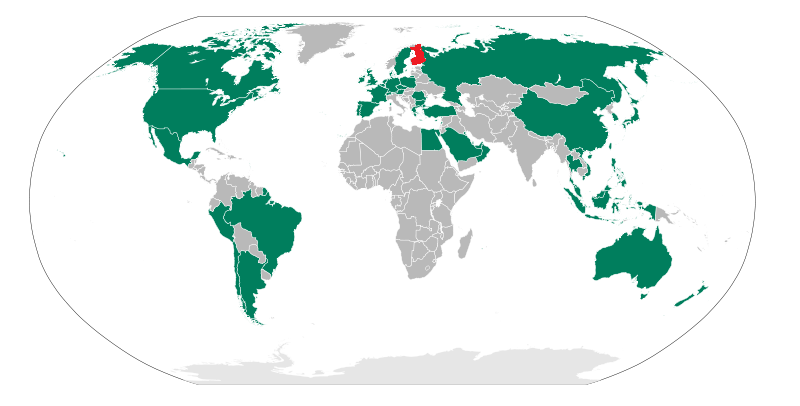
I have been watching Starbucks enjoying tremendous growth and expansion to foreign countries for years now. Previously I thought that the expansion can’t be so hard for Starbucks, the worldwide known giant. Just choose a country and go there! Or not ‘there’, here, Finland! However, the expansion isn’t as simple as just going to the foreign market and painting parts of the world map with your company color - obviously, when entering a new market, the company needs to choose the most appropriate entry mode. At the moment Starbucks uses only three different entry modes: joint ventures, licenses and wholly-owned subsidiaries (1). So which one would be best for the Finnish market?

 
Starbucks’ locations

Starbucks Corporation is organized into two business units that correspond to the company's operating segments: North America and Starbucks Coffee International. In the Unites States, the stores are largely company-owned with no partnerships. However, Starbucks Coffee International has adopted quite an opposite strategy, in which it forms joint ventures or licenses with local companies. The idea is that an experienced local partner can help identify locations, sift through tax issues and give Starbucks stores more community appeal (2). This being said and because of Starbucks’ lack of experience and know-how in Finland, I think the company should enter the market on a joint venture or licensing basis.

Licensing & Joint Ventures
Initially Starbucks expanded internationally by licensing its format to capable and reputable foreign operators to develop and operate new Starbucks stores. Licensing is an effective strategy given that Starbucks needs to uphold its service and product quality. When entering into licensing arrangements Starbucks can provide the Starbucks Experience in locations including local department stores, hotels, college and university campuses, hospitals, airports and grocery stores (3). Actually, Starbucks is already having a licensing agreement in Finland with SSP, the leading operator of food and beverage brands in travel locations worldwide (4). However, Starbucks hasn’t been totally happy with their pure licensing strategies because they do not give Starbucks the control they need in ensuring that the licensees closely follow Starbucks’ successful formula.

Due to this, nowadays Starbucks has elected to expand internationally primarily through local joint ventures to whom it licenses its format, as opposed to a pure licensing strategy (6). Having elements of joint ventures can provide Starbucks with an increased ease of entry into the foreign market.  The three main potential benefits of joint ventures are that Starbucks can protect their sustainable competitive advantage, reduce their financial risk and get the benefit of knowing how well the US product will do in the foreign market through local adaptation (5).

Entry Mode to Finland
My recommendation is that Starbucks should continue to use the “joint venture meets licensing business” strategy also in Finland in order to mitigate the possible effects of risks. This structure has been very effective for Starbucks so far, and it minimizes business vulnerabilities. The combination gives Starbucks the best of the both worlds: the control to be sure the licensees are following its rules and both joint owners have the responsibility for growing Starbucks’ presence. An excellent example of this combination strategy is when Starbucks entered Japan. At the beginning Starbucks only licensed their format to Japanese operators, but later this became a bad decision because Starbucks did not have the authority to control the new businesses. Starbucks improved this situation adding to the license a joint venture, so both companies which participated as joint owners had the commitment and responsibility to work together in order to get the best results (i.e. sales) (6).

Sources
2. Coffee in a time of conflict: Starbucks' growth risks backlash, http://www.organicconsumers.org/starbucks/041603_starbucks_fair_trade_coffee.cfm

Starbucks, what are you waiting for!

Here is a more comprehensive matrix of the SWOT-analysis from my previous post. There seems to be many possibilities to make Starbucks and Finland a match made in heaven and turn the Finnish market into Starbucks advantage. Just take a look!


SWOT –analysis for bringing Starbucks to Finland
Strengths

S1 Positive working environment due to the company’s emphasis on the importance of employees
S2 Worldwide recognition, high quality and positive reputation (strong word-of mouth among the customers)
S3 Strong financial situation
S4 Strong ethical values
S5 Effective mission and strategy
S6 Unique Starbucks products (coffee containers, mugs etc.) enhance customer loyalty: no other coffee chain sell their own brand products currently in Finland
Weaknesses

W1 Relatively high prices
W2 Blurring of company’s core concept by expansion of the assortment of products
W3 Inflexible pricing
W4 Not as well-established as competitors
W5 Centralized business plan
Opportunities

O1 Many high educated and internationally-minded people in Finland
O2 High economic level in Finland
O3 Tremendous coffee market in Finland
O4 Convenient and efficient distribution possibilities in Finland
O5 Portfolio of products in grocery stores
O6 Strong filter coffee culture in Finland is different from Starbucks’ concept


SO1 Company’s image matches the potential consumer market in Finland
SO2 Finns are experienced coffee drinkers and welcome innovative quality products
SO3 Financial status and coffee consumption reduces the risk of entering the Finnish market
SO4 Easy to find the largest markets in the south with minimal environmental impacts
SO5 Possibility to have a better focus on their relationship with Arla and grocery stores
SO6 Starbucks can bring its own, strong culture to Finland and shape coffee culture in a profitable direction


WO1 Finns are likely to be willing to pay extra for quality
WO2 Starbucks international character is the key to success not necessarily product range
WO3 Starbucks current pricing is presumably suitable for Finnish customers
WO4 Location, location, location (not only the airport!)
WO5 Not necessary to make tremendous changes for the Finnish market
Threats

T1 Starbucks’ lack of knowledge of the Finnish market
T2 Already existing competition
T3 Minimal visibility if the only location is the airport
T4 Criticism against the “evil” corporate character of Starbucks
T5 The fragmented competition: the number of substitute products is increasing which toughens the rivalry


ST1 Improve the positive image around Starbucks’ products
ST2 Starbucks’ worldwide acknowledged brand has the certain advantage over existing competitors
ST3 Expansion to the big cities in Finland is desirable
ST4 Starbucks needs to maintain its efforts to be socially responsible.
ST5 Starbucks needs to use its strong marketing techniques and experience to introduce Finns to its innovative products


WT1 High prices should be an instrument to emphasize on the company exclusiveness
WT2 With the expansion of the company’s products, Starbucks should promote  its advantage over competitors
WT3 Pricing can be consistent throughout Finland
WT4 Starbucks should further develop its social responsibility and its reputation
WT5 Starbucks needs to be open to learn about the biggest coffee consumer in the world, Finland

Why has Starbucks not penetrated the Finnish market yet?


The reason why Starbucks hasn’t entered the Finnish market is still a mystery to me. By annual consumption of coffee, as of 2008, Finland is the biggest consumer with 12 kg per person. Norway as the second biggest consumer with 9,9kg doesn’t even give the Finns a good run for their money!
An excellent tool to get a deeper understanding of Starbucks is SWOT analysis. In this case the SWOT-analysis focuses on the export policy towards Finland. In order to get a coherent picture I decided to divide the SWOT into internal (SW) and external analysis (OT). The internal analysis focuses on the internal factors that characterize Starbucks; its purpose is to attain insight in the success-increasing and the value-decreasing factors in the organization. The external analysis, on the other hand, focuses on the factors which can have an influence on the success of Starbucks entering Finland.

Strengths
  • Starbucks has no hierarchical organizational structure or formal organizational chart. The company believes that its employees are one of the most important assets and in Starbucks’ company language an employee is called a partner.
  • Starbucks’ products have an image of high quality. Starbucks itself is worldwide recognized and has a trendy image; it’s considered even popular to visit Starbucks.
  • Starbucks’ strong financial position is a proof that they are capable of entering new markets although they already have enormous number of locations worldwide.
  • The organization has strong ethical values and an ethical mission statement that 'Starbucks is committed to a role of environmental leadership in all facets of our business.'
  • Starbucks’ mission to make its stores a third place for people to go besides work and home comes by offering services like free internet and cozy atmosphere.
  • Starbucks is the only coffee chain with their own logistics chains for guaranteeing freshness an quality of coffee
Weaknesses:
  • Starbucks’ products have relatively high prices.
  • Due to the extension of the product portfolio, the company has got further away from its initial core-concept, and it is sometimes described as the “McDonald’s of coffee”.
  • Starbucks is pretty inflexible with their pricing. For example, they have the same price for their products whether you’re in LA or Beijing.
  • Their business isn’t as well established internationally as for example McDonalds.
  • In general, Starbucks has kept their business plan pretty centralized and they try to keep their branches as untailored as possible in different locations.
Opportunities:
  • Finns are, in general, high educated and internationally-minded.
  • There is pretty high economic level in Finland.
  • Finland has a tremendous coffee culture. Furthermore, Starbucks opportunity is in the coffee shop culture which is still in its infancy
  • Finland offers convenient and efficient distribution possibilities: potential consumers of Starbucks are to be found in the large cities which are almost all located in the South.
  • Starbucks has good opportunities to improve their market share and get more visibility by further expanding their portfolio of products, such as bottled Frappucinos and other specialty goods, in Finnish grocery stores.                                 
Threats:
  • Existing Finnish brands and competitors in the coffee business (even McDonald’s is now offering quality coffee).
  • If Starbucks decides to stay only in the airport they won’t get high visibility locations to attract Finnish customers.
  • Being a major worldwide corporation Starbucks is subject to many critical opinions from different corners of society: criticism against the “evil” corporate character of Starbucks and Starbucks leaving small coffee store-owners no choice but to give in and close their stores.
  • Starbucks may lack knowledge of the Finnish market.

So as you can see Starbucks has some weaknesses as a company and there are some threats when considering entry to the Finnish market. However, these are not insuperable problems and in my next post I will try to convince you how Starbucks can turn these weaknesses and threats into opportunities in the Finnish market.

Sources:
Finnish coffee: preserving a Scandinavian tradition. Retrieved on Feb 3, 2012, http://www.luxner.com/cgi-bin/view_article.cgi?articleID=59Finnish people and lifestyle. Retrieved on Feb 3, 2012:
http://www.squidoo.com/finish-people-and-life-style
Helsinki Times, Finns love affair with coffee continues despite rising prices. Retrieved on Feb 3, 2012: http://www.helsinkitimes.fi/htimes/eat-and-drink/16241-finns-love-affair-with-coffee-continues-despite-rising-prices.htmlShaun Weston, Starbucks premium iced coffee now available in Finland. Retrieved on Feb 3, 2012:
http://www.foodbev.com/news/starbucks-premium-iced-coffee-now-availa
Starbucks, monoculture, and American Imperialism. Retrieved on Feb 3, 2012: http://www.everything2.com/index.pl?node_id=1535254
 Starbucks Website. Business ethichs and compliance. Retrieved on Feb 3, 2012: http://assets.starbucks.com/assets/sobc-english-2011-09-01.pdf
 Starbucks Website. Our Company. Retrieved on Feb 3, 2012:
 Wikipedia, List of countries by coffee consumption per capita. Retrieved on Feb 3, 2012: http://en.wikipedia.org/wiki/List_of_countries_by_coffee_consumption_per_capita